Case Study
Removing Friction & Defining System-Level Navigation
CONTEXT
Over time, navigation emerged as one of the most frequent pain points: 23% of agents reported difficulties, often working across multiple browser tabs – leading to frustration and loss of productivity.
Product management framed this as an inconsistency problem and asked design to harmonize navigation patterns and define link and back-button rules.
Product overview
Sales Digital Workstation (SDW) is a CRM platform used by 40k+ insurance agents across multiple markets, serving over 21M customers.
THE REAL PROBLEM (NOT THE BRIEF)
Navigation complaints were a symptom, not the root cause.
Leadership treated the platform as an ecosystem of independent apps configurable per market. Agents, however, experienced it as a single application supporting continuous workflows across tools.
This mental-model mismatch led agents to rely on browser tabs and workarounds, increasing cognitive load and making incremental navigation fixes ineffective.
WHY THIS MATTERED
Navigation decisions were being made locally by product teams. Without a shared navigation strategy, each new app or market increased inconsistency across the platform. This required a strategic shift to protect platform coherence and user experience.
THE BET
Despite pressure to deliver quick harmonization, I reframed navigation as a system-level decision.
The bet was to redefine the product as one application, not an ecosystem of apps – treating apps as features within a shared navigation model, while preserving commercial configurability across markets.
Options considered
1. HARMONIZE BACK BUTTONS AND LINK BEHAVIOR (REJECTED)
This option required defining many conditional rules (“sometimes new tab, sometimes same tab”), risking long-term inconsistency and user confusion.
2. IN-APP TABS, SALESFORCE-STYLE (REJECTED)
In-app tabs conflicted with browser-native tab behavior, and was conceptually and technically complex – risking increased long-term maintenance cost without obvious benefit for the user.
3. SYSTEM-LEVEL NAVIGATION MODEL (RECOMMENDED)
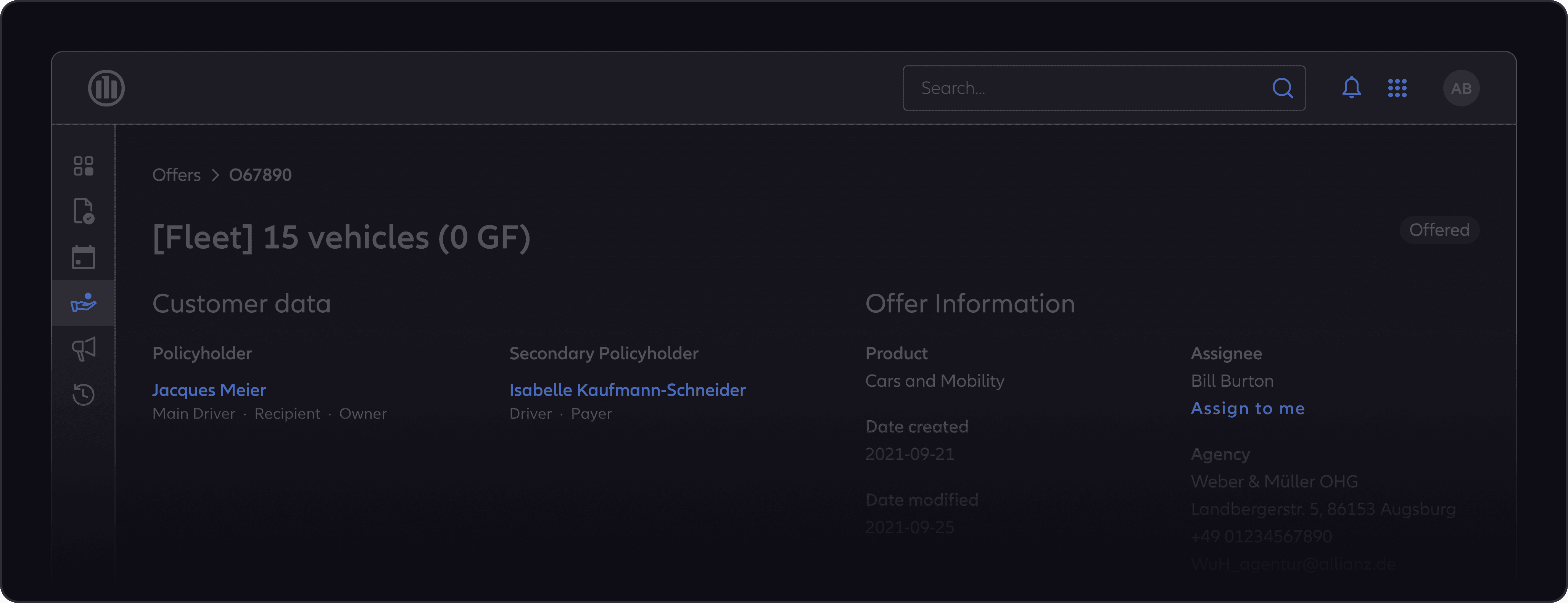
Moving apps into a persistent left-side navigation & breadcrumb makes cross-app switching visible and predictable – thus supporting workflow continuity, and multitasking.
Outcomes
Proposal was directional, not shipped
Architecture team aligned strongly with the direction
A shared language emerged: one application vs ecosystem
Even without implementation, the work prevented ineffective local optimizations and created a reference point for future scaling discussions.
Would you’d like to dig deeper into the tradeoffs, constraints, or decision-making behind this work?
Reach out, I'm happy to talk.